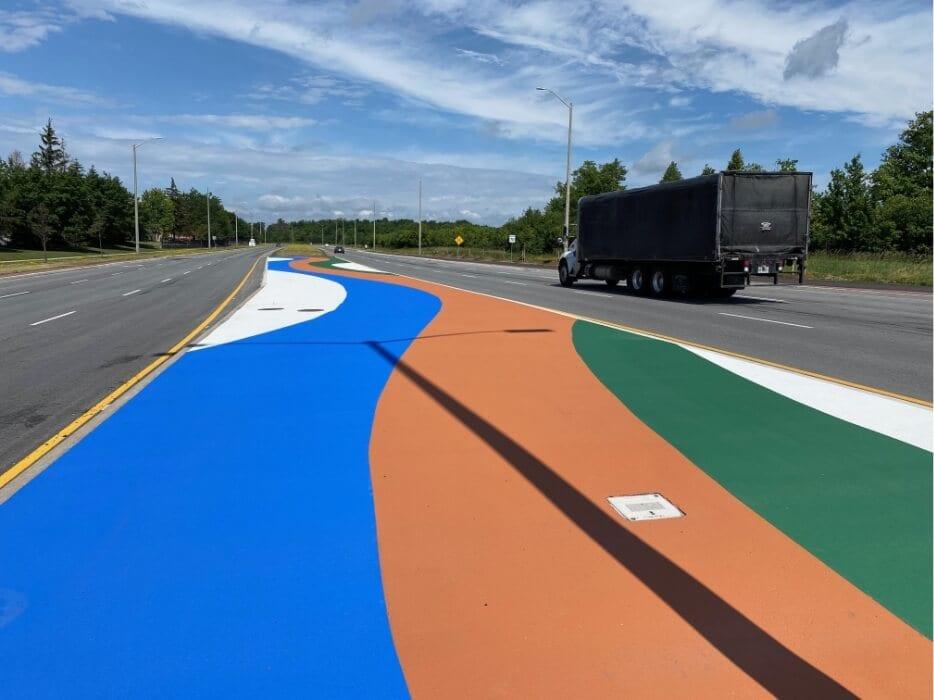
Snowplow blades, road salt and freeze-thaw are what actually decide whether a decorative surface survives in Canada. Here is what makes a surface plow-safe, and what does not.
Every decorative pavement product looks good in July.
The question a Canadian municipality actually has to answer is what the surface looks like in April, after a winter of plow blades, road salt, and the freeze-thaw cycling that takes ordinary markings apart. Most of the decorative surface failures we get called about are not colour failures. They are profile failures: something stood proud of the road, and a steel blade found it.
Here is what separates a surface that survives that from one that does not.
1. Fused into the asphalt, not laid on top of it
Preformed thermoplastic is heat-applied: it melts into the asphalt and becomes part of it. There is no adhesive layer, no membrane, no edge for a blade to lift.
That is the difference between a marking that is in the road and one that is on it, and it is the single biggest predictor of whether a surface makes it through February.
2. Aggregate through the full cross-section
Anti-skid aggregate can be handled two ways: broadcast across the top of a material, or intermixed through its full thickness.
Broadcast aggregate wears off. The surface starts grippy and gets slick as the top layer goes.
HUB's preformed thermoplastic carries the aggregate all the way through the cross-section, so the grip lasts as long as the colour:
- TrafficPatterns: 125 mil, 60 BPN skid resistance (ASTM E303), 8+ year service life
- TrafficPatternsXD: 150 mil, aggregate rated 8–9 on the Mohs scale, 60 BPN, 10+ year service life
Eight to nine on the Mohs scale puts that aggregate just below diamond. It is not a decorative inclusion; it is the wearing surface.
3. Zero profile above grade
Two systems solve the plow problem by refusing to have a profile at all.
StreetPrint stamps the pattern into the asphalt. The surface stays flush: nothing to catch, no joints to weed, no pavers to settle, and the asphalt stays flexible through the freeze-thaw cycle.
DuraTherm inlays thermoplastic into a stamped impression, so the finished surface sits flush with the road. Zero profile above grade, nothing to trip on, no shear damage through winter maintenance. When a decorative crosswalk has to live on a plow route, this is the detail that makes it possible.
What this rules out
It is worth being direct about the comparison, because the alternative usually on the table is interlocking pavers.
Pavers are a unit system with joints and a raised edge profile. In a climate that plows and salts, that geometry means units that shift and heave, joints that weed, and edges a blade can catch. Nothing about that is a manufacturing defect. It is what a unit paving system is.
A stamped or fused surface has none of those features, because it has no units.
Specifying for winter
If the surface is on a plow route, three questions settle most of it:
- Is it flush with the road? If anything stands proud, the blade will find it.
- Is the material bonded to the asphalt, or attached to it? Heat-fused survives; adhered wears at the edges.
- Where is the aggregate? Through the section, or on top of it.
Get those three right and the surface is doing its decorative job for a decade rather than a season.