Painted crosswalk markings lose retroreflectivity quickly under Canadian conditions, fading fastest in wet weather, which is exactly when pedestrian visibility matters most. Here's why preformed thermoplastic has become the Vision Zero specification standard.
Vision Zero is a commitment to the proposition that traffic fatalities are not an acceptable cost of urban mobility, that with the right infrastructure and design choices, the number of people killed on streets can be reduced to zero. In Canada, that commitment is increasingly common in municipal policy documents.
The infrastructure needs to match the policy. Crosswalk markings that fade within a season (invisible in rain, chalked white on dry pavement, sheared at the edges by snowplow blades) are not Vision Zero infrastructure. They are a placeholder.
The Problem with Painted Crosswalks
Traffic paint is cheap at installation. Its total cost, properly accounted for, is not.
Painted crosswalk markings degrade rapidly under the specific combination of stresses that Canadian municipal infrastructure faces: freeze-thaw cycling that opens micro-cracks in the paint film, de-icing chemicals that attack the adhesion layer, turning vehicle wheels that create lateral shear, and snowplow operations that catch any raised surface profile and peel it away. Retroreflectivity (the property that makes a crosswalk visible to a driver at night, in rain) deteriorates fastest because the glass beads are only applied to the surface of painted markings and wear away with traffic.
The result: crosswalk markings that look good in the season they were installed and require repainting within one to two seasons on arterial roads. Every repainting cycle means a lane closure, a crew deployment, and a gap in the maintenance schedule where the crosswalk is performing below specification.
For municipalities with Vision Zero programs, the repainting cycle isn't just a maintenance cost. It's a safety gap that occurs on a known, predictable schedule.
Preformed Thermoplastic: The Municipal Standard
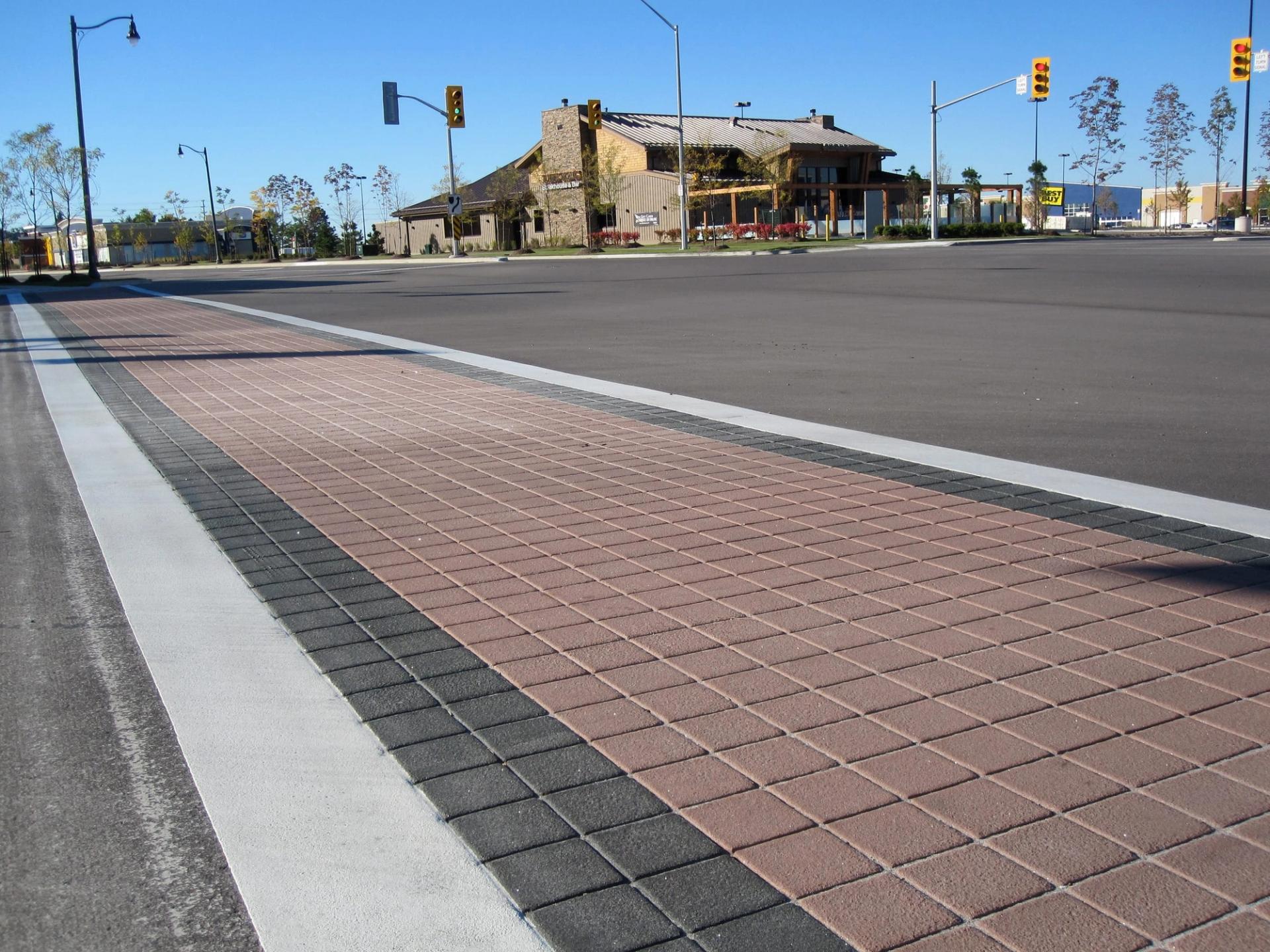
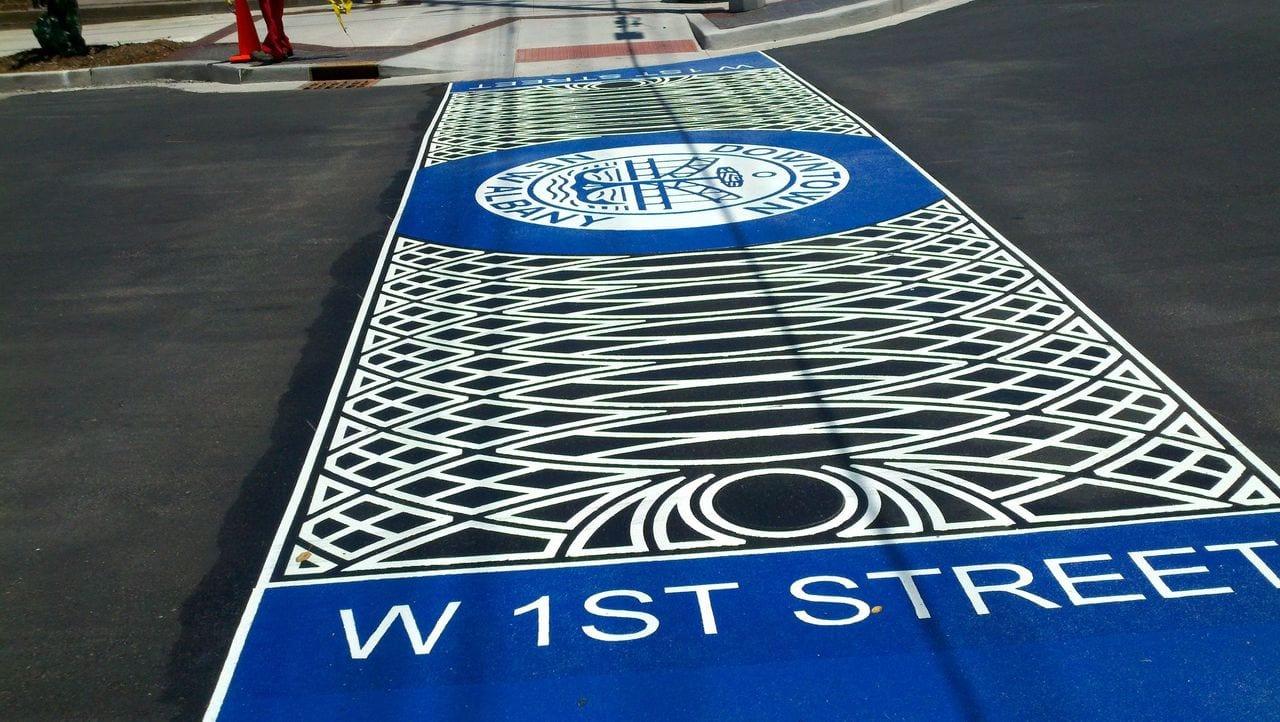
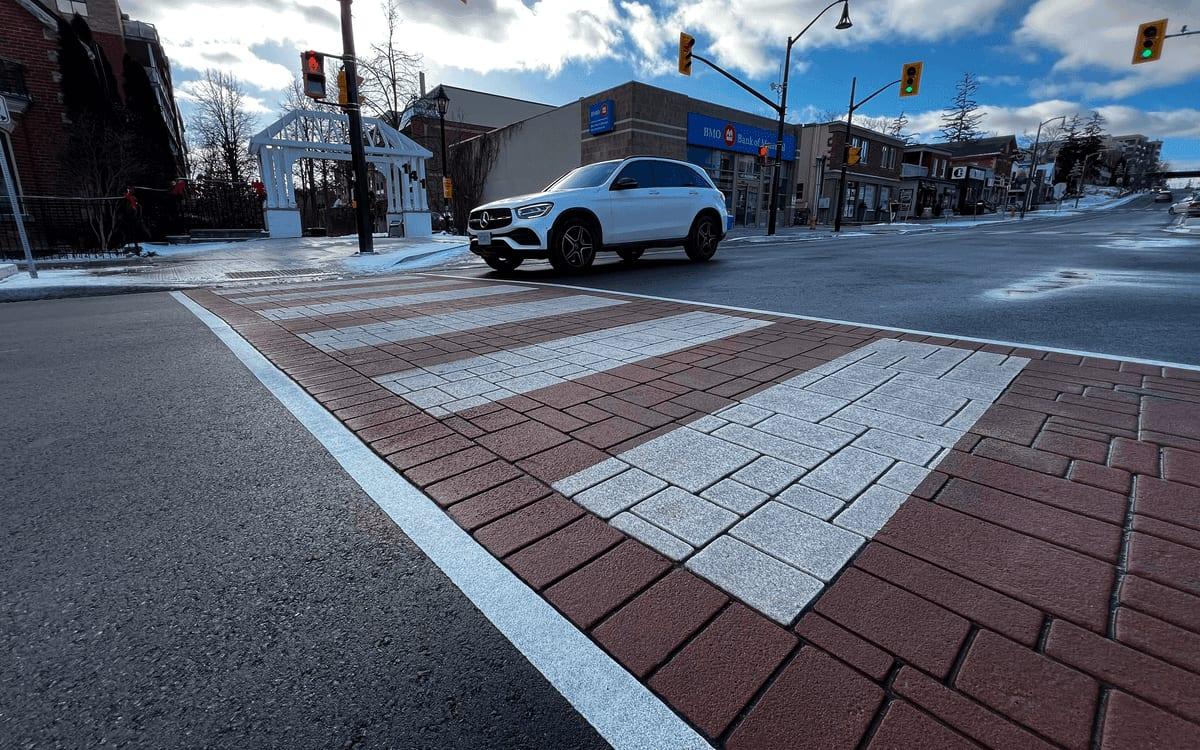
TrafficPatterns and TrafficPatternsXD are preformed thermoplastic systems factory-manufactured to precise thickness specifications: 90mil for standard applications, 150mil for heavy-use intersections and BRT corridors. They are thermally bonded directly to the asphalt substrate in a monolithic fusion: not an adhesive layer, not a coating sitting on top of the surface, but a material that becomes part of the road.
This fundamental difference in how the product bonds to the pavement is what drives the performance difference. The thermoplastic expands and contracts with the pavement through Canadian freeze-thaw cycles. It doesn't develop the adhesion failures that cause paint to peel. The glass beads that provide retroreflectivity are distributed throughout the material cross-section, not just at the surface. So as the top layer wears, fresh beads are exposed, maintaining retroreflective performance through the full service life of the marking.
The practical outcome: crosswalks that hold their specification (visible, retroreflective, high-contrast) season after season without repainting. BPN 65+ certified skid resistance maintained throughout service life. Zero documented edge damage from snowplow operations in municipal installations.
Vision Zero Applications Across Canada
York Region, the City of Toronto, the City of Vancouver, and the City of Richmond have all specified TrafficPatternsXD for their highest-priority pedestrian safety corridors. The Brighouse Station intersection in Richmond, a complex multi-modal crossing with significant pedestrian, cyclist, and transit volumes, has maintained full retroreflective performance through multiple consecutive winters since installation.
Where municipalities have made the shift from painted to thermoplastic crosswalk systems, maintenance teams report the most obvious change: they stop getting called back. The crosswalk holds.
The Lifecycle Cost Argument
The specification decision comes down to total cost over the life of the installation, not installation cost alone.
Painted crosswalks carry low initial cost and high ongoing cost: repainting frequency, crew time, lane closure management, and the productivity loss for the crews who could have been doing other work. Thermoplastic crosswalks carry higher initial cost and near-zero ongoing cost. Over the full maintenance cycle of a crosswalk network, thermoplastic systems are consistently the lower-cost option in Canadian conditions, while delivering measurably better safety performance throughout.
For municipalities managing crosswalk networks at scale, that difference compounds significantly.
Specifying for Your Municipality
HUB Surface Systems provides full specification support for municipal crosswalk programs, from pattern and colour selection to installation contractor coordination and technical documentation for procurement. Our Lunch & Learn sessions put the technical details in front of traffic engineers and public works professionals, lunch included.
Book a Lunch & Learn Session to discuss Vision Zero crosswalk specifications for your municipality.