A manifesto on why the surfaces we walk on matter, and why HUB Surface Systems has spent 27 years giving Canadian communities the tools to say something with their streets.
Stand at the corner of Commercial Drive and Venables in Vancouver and look down.
The crosswalk you're standing on is the Italian flag: three wide bands of green, white, and red, rendered in thermoplastic that has survived every Vancouver winter since installation. People cross it forty times a day without breaking stride. But something happens when you cross it for the first time. You feel where you are. You know you're in Little Italy, even if no sign said so, even if you've never been here before. The ground told you.
Or stand outside BC Children's Hospital and follow the labyrinth embedded in the courtyard surface. StreetBond, coloured in a spiral path that winds inward and back. Parents walk it while their children are in surgery. It is therapeutic infrastructure, built into the ground plane of a building that exists to heal. No one drew a line between wayfinding and emotional design. They are the same thing, here.
Or stand where the Every Child Matters crosswalk has been installed in any of dozens of Canadian municipalities. Orange thermoplastic. A phrase that carries the weight of a nation's uncompleted reckoning. You cross it to get to the post office. You cross it to get to school. You cross it every day, and it crosses you back.
Streets have always been the original public medium.
Before billboards. Before social media. Before broadcast. Cities communicated who they were through their public surfaces. Roman roads said empire. Cobblestone said permanence. Brick said the kind of craftsmanship a community was willing to invest in the place between buildings. The ground plane was never just infrastructure. It was always also language.
Grey asphalt is a modern invention. And a modern abdication. The decision, made across a century of North American urbanism, to treat the horizontal surface as pure utility, as something to get across rather than something to be in, cost something real. Not just aesthetically. Experientially. Psychologically. A grey city does not feel like a city that cares about itself.
The good news: grey was always a choice. And it can be un-chosen.
For 27 years, HUB Surface Systems has been in the business of giving communities the tools to say something with their streets.
We don't make signs. We don't make furniture. We make the surface itself expressive. StreetPrint, pressing dimensional pattern into asphalt until it reads as stone. StreetBond, coating grey with colour that will still be there long after a painted alternative has faded to nothing. DecoMark, reproducing a First Nation's cultural artwork at crosswalk scale with Pantone precision. TrafficPatternsXD, turning a fire lane demarcation into a heritage-brick design element.
The products are not the point. The point is what happens when a community decides the ground it walks on should communicate something about who it is.
Cities are physical arguments. Every decision about public space is an argument about what matters, whose story gets told, which communities get represented in the shared environment.
The street is one of the few remaining common spaces: not owned, not gated, not algorithmically sorted. Everyone crosses the same crosswalk. Everyone walks the same pathway. When that surface carries meaning, it carries meaning for everyone.
That is why the Every Child Matters crosswalk matters more than a building lobby mural. It is in the public right-of-way. It cannot be opted out of. You encounter it as you encounter the city, as a given, as the shared ground.
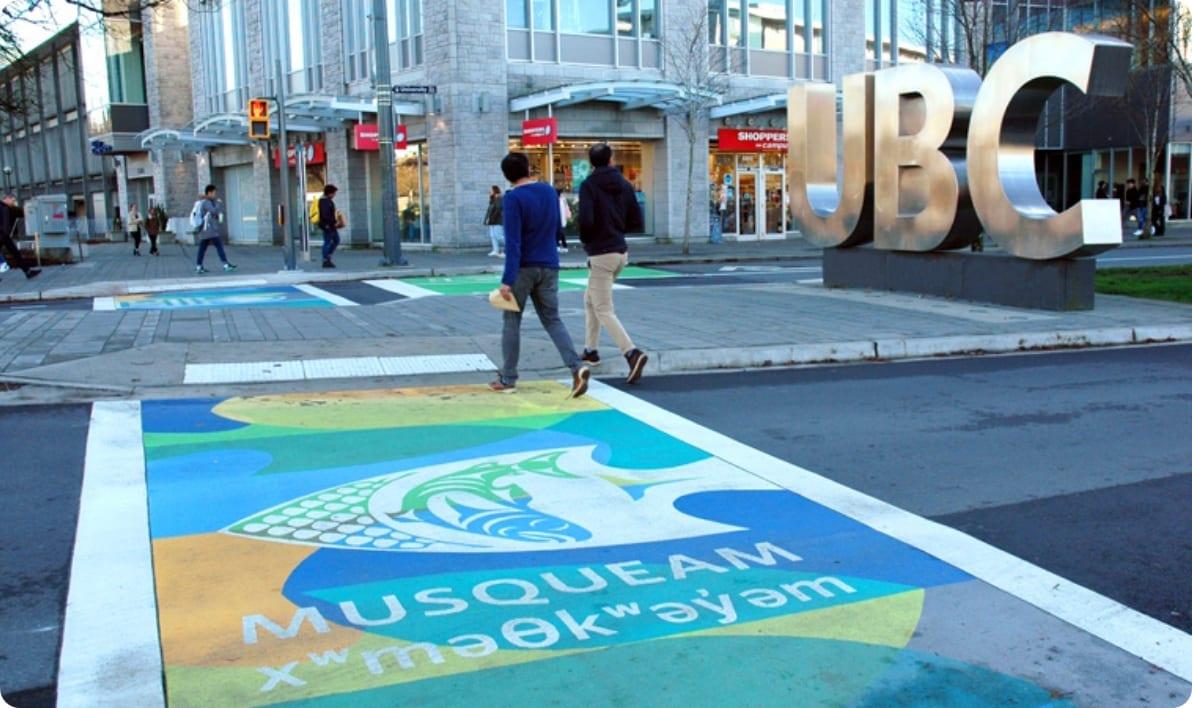
That is why the Musqueam crosswalk at UBC is not decoration. It is acknowledgement, at the scale of infrastructure. It says: this land has a story older than this institution, and that story is present here, underfoot, always.
That is why a community deciding to install an Italian flag crosswalk on their commercial corridor is an act of civic self-authorship. They decided what their street says. They used a commercial district's most-crossed intersection as the medium.
We have spent 27 years believing that the ground matters.
Not because pavement is precious. Because what we build together in public says something about what we think of each other. Because the street is the one space every member of a community shares. Because if civic infrastructure can be beautiful, can be culturally resonant, legible, and meaningful, then it should be.
The street is your canvas.
We would love to help you decide what to put on it.