As cities reduce visual clutter and pedestrian attention shifts downward, horizontal surface signage and wayfinding is emerging as one of the most effective tools in the urban designer's toolkit.
Walk through any major Canadian transit hub at rush hour and watch where people look. Not up at the overhead signs. Down. At their phones, at the ground, at the three metres in front of them. Pedestrian attention has shifted downward, and the urban design community is responding.
Surface signage (wayfinding, directional graphics, zone identification, regulatory markings) applied to the ground plane has emerged as one of the most effective tools in the urban designer and transit planner's toolkit. The evidence is straightforward: people see what is in their field of view. For pedestrians in motion, that field is mostly horizontal.
The Evidence for Horizontal Wayfinding
Research on pedestrian navigation behaviour consistently finds that ground-level cues (coloured surfaces, directional arrows, tactile elements) are processed more reliably than overhead signs, particularly in high-crowd, high-distraction environments like transit interchanges and commercial hubs.
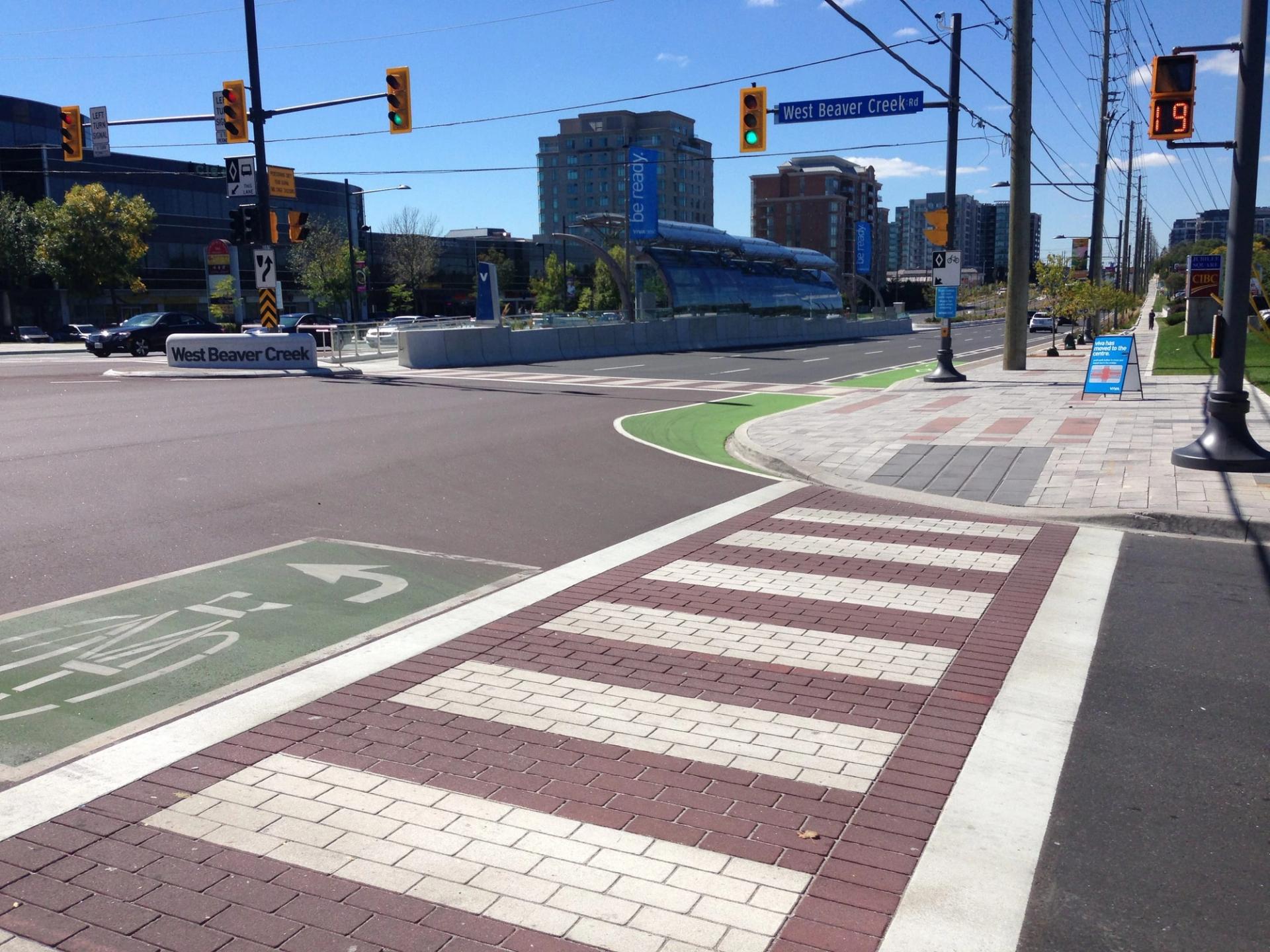
The design implication is direct: in complex environments, put the wayfinding where people are looking. This is why airports have evolved from overhead-only sign systems to integrated floor-level direction indicators. It is why transit authorities are specifying coloured bus lanes, green bike lanes, and surface-embedded directional graphics. The ground is the new sign system.
DecoMark: Precision Wayfinding at Street Scale
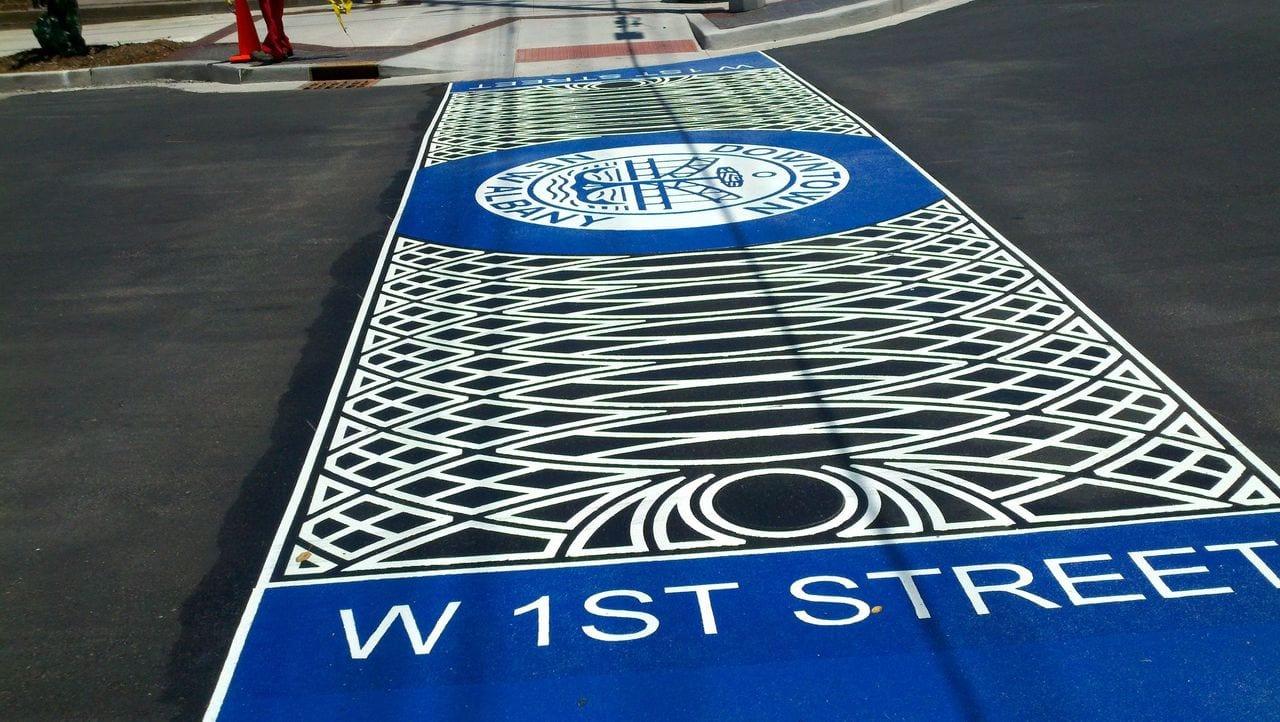
DecoMark is the surface wayfinding medium of choice for projects that require accuracy, durability, and design quality. As a preformed thermoplastic system manufactured to Pantone specification, DecoMark can reproduce:
Directional arrows: standard regulatory arrow formats for vehicle and pedestrian guidance, or custom arrow designs integrated with a wayfinding design system.
Distance and destination markers: text and numeric graphics at pavement scale. Zone identifiers, floor-level stop names, destination callouts.
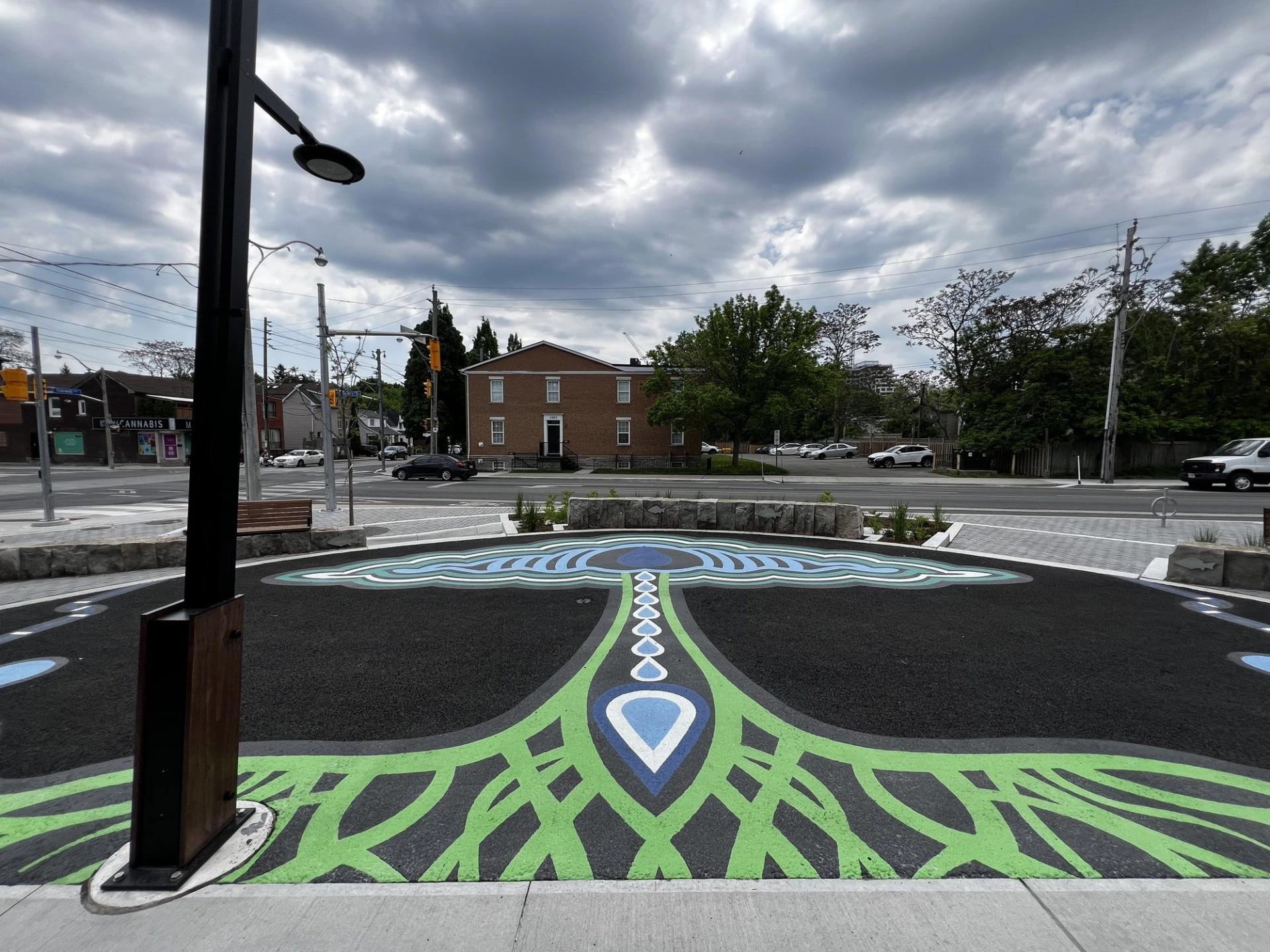
Zone boundary graphics: line work, colour fills, and pattern elements that define zones within a complex environment.
Accessibility symbols: international accessibility and accessibility-compliant symbols at specified dimensions and colour contrasts.
All at UV-stable, traffic-bearing quality. A DecoMark wayfinding installation in a transit hub bears the same vehicle and pedestrian loads as the road surface around it, with colour retention and edge definition measured in years, not seasons.
Airport and Transit Hub Applications
AirMark, HUB's aviation-specific surface system, addresses the most demanding wayfinding environment: the airfield and terminal ground plane. Taxiway centrelines, hold position markings, speed markings, and apron zone identifiers must be reproduced with absolute accuracy, sustained under the wheel loads of commercial aircraft, and maintained under continuous exposure to jet wash and de-icing chemicals.
The same principles apply at ground level: Brighouse Station in Richmond is a reference installation for transit hub surface wayfinding. The station approach and platform-level surfaces use surface markings to guide passengers through a complex multi-modal interchange (bus, Canada Line, pedestrian) with surface graphics that direct flow and identify zones without requiring passengers to look up and locate a sign.
PreMark regulatory markings serve the same function in standard traffic environments. Turn arrows, stop bars, lane assignments, and yield markings at intersections and access points: preformed thermoplastic with precision dimensional accuracy and 6–8x the lifespan of spray-applied paint.
School and Hospital Environments
Schools and hospitals have specific wayfinding requirements: populations with varying literacy, navigation ability, and physical capability; multiple distinct zones (emergency, visitor, staff, service) with real consequences for zone confusion; and high-traffic environments where clarity of movement reduces conflict and risk.
Colour-coded accessible route markings guide low-mobility users through campus environments without barriers or overhead complexity. Emergency exit route markings at floor level are visible even in smoke or low-visibility conditions. BC Children's Hospital's decorative labyrinth installation demonstrates that surface design in healthcare environments can be simultaneously therapeutic, wayfinding, and expressive: the surface does multiple communicative jobs at once.
Zone identification through surface colour (a green accessible route, a red emergency access lane, a blue wayfinding path to a specific facility) enables navigation by colour code that requires no reading, no upward gaze, and no significant cognitive load.
Urban Placemaking Without Vertical Clutter
Many municipalities are actively working to reduce street furniture and signage clutter. The proliferation of sign poles, overhead banners, and street-level advertising is a livability problem: cities feel less human when every surface is competing for attention. Moving wayfinding and district identity to the ground plane is one response.
A coloured district boundary crosswalk defines neighbourhoods without a sign. A surface-embedded directional arrow guides pedestrians without a pole-mounted sign cluttering the sidewalk. A destination marker in the ground plane informs without interrupting the visual environment above knee height.
This is why municipalities like the Spirit Trail approach in Vancouver (continuous colour treatment on a connected greenway corridor) communicate network identity more effectively than any sign system could. The surface is the sign.
Getting the Specification Right
Surface wayfinding projects succeed or fail in the specification phase. The key variables: product selection matched to traffic type (pedestrian-only vs. vehicle-bearing), dimensional accuracy requirements for regulatory markings, colour specification (Pantone-matched for design-system integration), and installation sequencing in active environments.
HUB Surface Systems works with transit authorities, municipalities, airport operators, healthcare institutions, and urban designers on surface wayfinding specifications. We carry the full product range (DecoMark, PreMark, AirMark, StreetBond) and the 30-year installation track record to support complex projects.
The best wayfinding is the kind users never consciously notice: they just end up where they were going. Put it where they're looking.
Book a Lunch & Learn to explore surface wayfinding systems with your planning or design team, or contact us for project consultation.